Frying oil should work hard. It shouldn't give up early.
When oil darkens, smokes, foams, or simply stops producing the food quality you expect sooner than it should, replacing the oil solves the immediate problem. But it doesn't necessarily solve the underlying issues.
Oil life is shaped by what happens around the oil every day. Temperature, food moisture, breading, salt, crumbs, cleaning, filtration, top-off practices, idle time, and the oil itself can all influence performance.
The better troubleshooting question to ask: What's happening in this kitchen that could be shortening our frying oil life?
What causes frying oil to break down faster than it should?
There is rarely one universal answer. Oil type is one factor. The type of food being fried is another. For example, a high-volume chicken program puts different demands on oil than a fryer dedicated to french fries. Two kitchens using the same oil can see very different results.
So before changing products, look at the operation to determine your best oil for frying. Ensure that there is clear documentation regarding oil usage and maintenance.
| Action to take | What to check first |
|---|---|
| Check the heat | Verify actual temperature. Don't assume the thermostat setting tells the whole story. |
| Watch water and ice | Look at how much moisture enters the fryer with frozen or wet foods. |
| Control breading & crumbs | Excess breading, fines, and food debris can accumulate quickly. |
| Pay attention to salt | Review where and when fried foods are seasoned. |
| Keep the fryer clean | Look at fryer cleanliness and whether debris is being removed effectively. |
| Review filtration | Consider filtration frequency and consistency, especially during heavy production. |
| Look at oil management | Review top-off practices, idle periods, production volume, and oil turnover. |
| Match the oil to the job | Make sure the frying oil fits the menu, equipment, volume, and performance expectations. |
Isolate the cause. Don't chase it.
A common troubleshooting mistake is to change three or four things at once: the oil, the temperature, filtering, or even cook time.
Performance improves, but nobody knows why. It's better to change one thing and measure results.
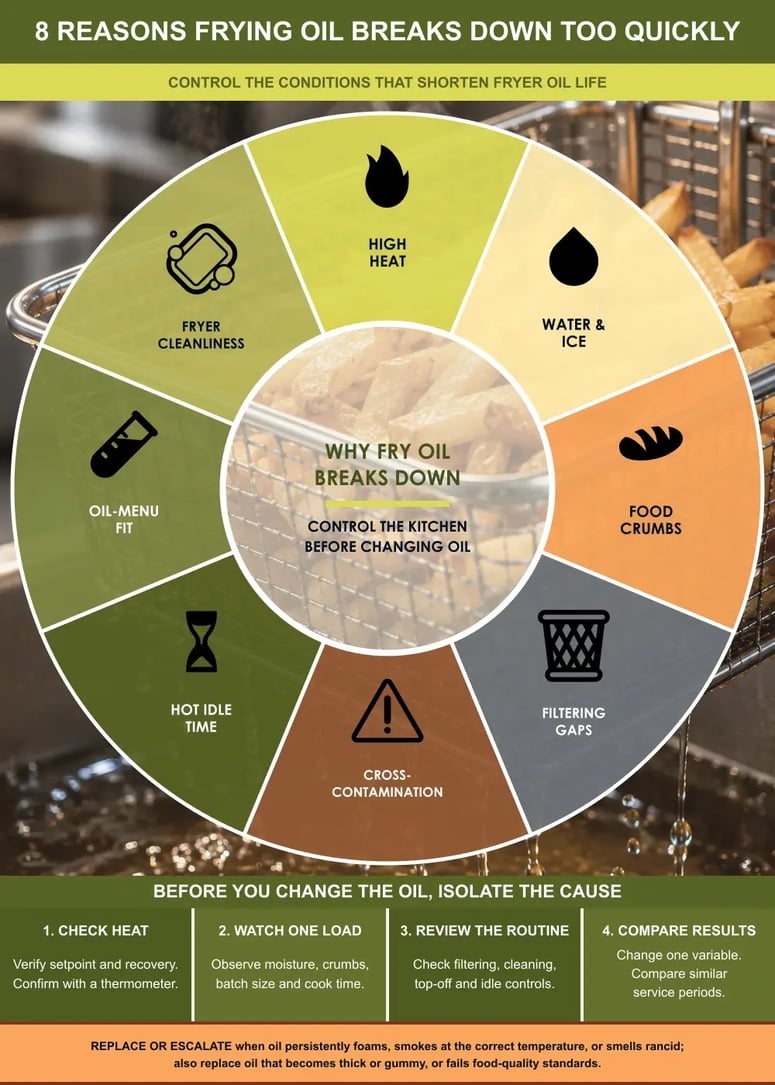
Start by defining what “breaking down too quickly” actually means in your operation. Is the oil getting dark, foaming excessively, or smoking? Are fried foods coming out darker than expected? Has flavor, texture, or consistency changed?
Next, verify the basics. Check fryer temperature. Review food handling, breading and seasoning practices. Look at crumb accumulation. Confirm cleaning and filtration routines. Review top-offs and idle periods.
Then change one variable and document what happens. Keep in mind that the best oil to fry chicken may not be the best oil to fry fish or other products.
The infographic below brings the major oil-life factors together in one quick reference and provides a simple four-step approach: identify the symptom, verify the basics, change one variable at a time, and document the result.
Short oil life is telling you something
Premature oil breakdown affects more than the fry oil budget. It can make fryer management harder and finished-food quality less predictable.
But short oil life is also information. Treat it as an operating signal. Look for what changed to identify patterns across shifts, menu items, deep frying, and production volumes. Give your team an easy, consistent way to record what they see.
Often, the path to longer oil life starts with a surprisingly ordinary detail.
Start with the checklist
For a quick reference at the fryer, use our Fry Oils Troubleshooting Guide to review common symptoms, possible causes, and corrective actions.
Still burning through frying oil?
Bring your observations and operating details to your local distributor for an application review. A good review should look beyond the oil itself and consider the menu, equipment, volume, procedures, and performance expectations.
Find the variable. Isolate the cause. Then decide what needs to change.
Educational sources: Oklahoma State University Extension | USDA FSIS | Foods (2024) frying oil review
Validate against fryer manufacturer guidance and site SOPs