
Dietary Fats in Oils:
An Overview
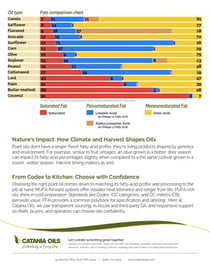
Plant-based oils are blends of fatty acids, and that blend is what drives both nutrition and kitchen performance. The three main types of fatty acids saturated, polyunsaturated, and monounsaturated fats all behave differently in the kitchen.

Reading Oils by Their Fatty Acids: SFA, PUFA, MUFA
Plant-based oils are blends of fatty acids, and that blend is what drives both nutrition and kitchen performance. The three main types of fatty acids saturated, polyunsaturated, and monounsaturated fats all behave differently in the kitchen.
- Saturated fatty acids (SFA), like those in coconut oil or palm oil, stay solid at room temperature and hold up to heat, but nutrition experts recommend using them in moderation.
- Polyunsaturated fatty acids (PUFA) - including linoleic acid (an Omega-6 fatty acid) and alpha-linolenic acid (an Omega-3 fatty acid), are commonly found in soybean, sunflower, and grapeseed oils. These oils are lighter and delicate, adding smooth texture to dressings and cold applications but breaking down faster under high heat.
- Monounsaturated fatty acids (MUFA) found in olive, canola, and avocado oils strike a balance between shelf-stable liquid and heart-healthy.
Beyond the Crop: Processing, Standards, and Real-World Stability
Processing and standards matter just as much as the crop. “Extra virgin” olive oils are defined by strict chemical and sensory criteria, while refined oils are purified to remove flavor compounds and free fatty acids, improving neutrality and consistency.
In addition, heat performance isn’t just about a single “smoke point” number. Real-world stability in sauté or continuous frying reflects fatty-acid profile. Oils high in MUFA (like high-oleic canola or olive) exhibit greater oxidative stability and longer fryer life due to fewer double bonds, while PUFA-rich oils (like traditional sunflower or soybean) oxidize more readily, limiting reuse cycles.
In industry and QA settings, labs often track oxidation via the Oil Stability Index (OSI) induction time and basic quality markers like peroxide value and free fatty acids to gauge freshness, turnover, and fryer life. Antioxidants (natural or permitted additives) can further delay oxidation and extend usable life for high-throughput operations.
These compositional differences are codified in Codex Alimentarius Standard 210, ensuring consistency in labeling, quality control, and health communication across global markets.
Nature’s Impact: How Climate and Harvest Shapes Oils
Plant oils don’t have a single “fixed” fatty acid profile; they’re living products shaped by genetics and environment. For example, similar to fruit vintages, an olive grown in a hotter, drier season can impact its fatty-acid percentages slightly when compared to a the same cultivar grown in a cooler, wetter season. Harvest timing matters as well.
From Codex to Kitchen: Choose with Confidence
Choosing the right plant oil comes down to matching its fatty-acid profile and processing to the job at hand. MUFA-forward options offer steadier heat tolerance and longer fryer life; PUFA-rich oils shine in cold preparation. Standards like Codex, IOC categories, and QC metrics (OSI, peroxide value, FFA) provides a common playbook for specification and labeling. Here at Catania Oils, we pair transparent sourcing, in-house and third-party QA, and responsive support so chefs, buyers, and operators can choose oils confidently.