The real opportunity for private brands isn't to replicate a packaging trend. It's to make a better everyday cooking experience accessible to more shoppers.
Squeeze bottles are becoming an increasingly familiar sight in the olive oil aisle. What initially gained traction with emerging brands has quickly expanded, with established national brands introducing their own squeeze offerings.
It's an interesting evolution to watch, but I think there's a risk in treating squeeze as simply the latest olive oil packaging trend, or assuming its appeal is limited to premium olive oil shoppers.
Squeeze isn't an olive oil innovation. It's a usage innovation that happens to have gained traction through olive oil.
And for private brands, I think that distinction opens up a much more interesting opportunity.
The unexpected value of small innovations
I've always believed there's something really special about product innovation that combines solving a problem with an unexpected moment of delight.
Sometimes the problems worth solving aren't particularly big. They're the small, everyday frustrations we've learned to live with. But when those frustrations happen frequently enough, removing them can have an outsized impact.
One of my favorite examples comes from a completely unrelated category: diapers.
As a mom, I've purchased more than my fair share of bulk diaper boxes. For years, opening them meant finding scissors to cut through the packing tape. It was such a routine part of the experience that I kept a pair in the nursery.
Then Pampers introduced a simple perforated tab that let me open the box without scissors.
Such a small change. But I loved it.
I didn't realize how much until my husband bought a competing brand, and suddenly I needed scissors again. I told him we were going back to Pampers.
The diapers themselves worked fine. But that small packaging improvement had become part of the value I associated with the brand.
That's what thoughtful innovation can do. It improves the experience in a way you might never have thought to ask for.
Why are we accepting the extra step?
Something similar is happening with cooking oil.
Professional kitchens and test kitchens have long used squeeze bottles to keep frequently used oils accessible and easier to dispense. Some home cooks have adopted the same behavior, transferring oil from its original package into countertop dispensers, pourers, or squeeze bottles. That can mean pouring oil into another bottle, wiping up a spill, and finding room for a second container.
Think about that for a moment.
Why are we asking another product to do a job the original package could do for us?
And what about the cooks who aren't decanting?
They're glugging oil into a skillet before sautéing, trying to drizzle it evenly over vegetables before roasting, or attempting to measure a teaspoon of canola oil from a large, wide-mouthed bottle.
Cooking sprays have already shown how useful application-focused packaging can be, expanding well beyond the original familiar offerings into different brands and oil varieties. But sprays serve a particular purpose: applying a light, even coating.
Large traditional bottles offer value when you're purchasing oil by volume, but they can be cumbersome for smaller, everyday applications.
Squeeze offers something in between. A lighter, more agile way to aim and control a stream of oil without wrestling with a larger bottle.
And that benefit isn't tied to one type of oil.
You might be reaching for canola oil when baking, vegetable oil for everyday pan cooking, avocado oil for high-heat applications, or extra virgin olive oil to finish a dish.
The cooking job changes. The usefulness of controlled dispensing remains.
It's not just about the bottle
There's another element of the squeeze bottle story worth considering: how brands connect product attributes to familiar usage occasions.
Take Graza, one of the early entrants in olive oil squeeze packaging, with its Sizzle, Drizzle, and Frizzle lineup.
The names are playful, but the underlying positioning is practical. Rather than relying solely on technical product attributes, the brand connects different oils to recognizable cooking applications.
And this isn't a new approach.
Gatorade applied a similar strategy when it introduced Prime, Perform, and Recover, organizing products around what athletes needed before, during, and after physical activity.
The concept is simple: help consumers understand which product is right for what they're trying to accomplish.
Cooking oils come with an enormous collection of attributes: extra virgin, refined, single-origin, cold-pressed, expeller-pressed, organic, Non-GMO, and more.
Those attributes can be meaningful. But they don't always make it easy for consumers to understand which oil is right for what they're trying to cook.
Good positioning isn't just about getting someone to buy your product. It's about helping them choose something that will actually deliver the experience they expect once they get home.
The private brand opportunity
This is where I think the conversation gets especially interesting.
Private brands have built strong relationships with shoppers by promising quality and value. But value is not just a dollar figure. It's the entire experience you're providing.
A shopper might appreciate the convenience of squeeze packaging but have no interest in purchasing a premium avocado or specialty olive oil. Maybe that's not the oil they cook with, or it's outside the price point they're comfortable paying.
Does that mean they wouldn't appreciate the same convenience in the canola or vegetable oil they use every week?
Of course not.
It may simply mean they haven't had an opportunity to choose it.
And unlike brands focused on one particular type of oil, retailer private brands can often span the entire cooking oil assortment.
That's an opportunity to look beyond a single premium olive oil application and consider where squeeze could provide meaningful value across the oils shoppers already know, use, and trust.
It doesn't mean every oil needs a squeeze bottle. The right assortment depends on your shoppers, their cooking habits, and where the format brings the greatest benefit.
But it does mean that squeeze deserves to be evaluated as more than a premium olive oil trend.
For private brands, that could mean making familiar oils more useful and giving shoppers another reason to return to a brand they already trust.
Because a better everyday cooking experience shouldn't have to be limited to one oil, one brand, or one type of consumer.
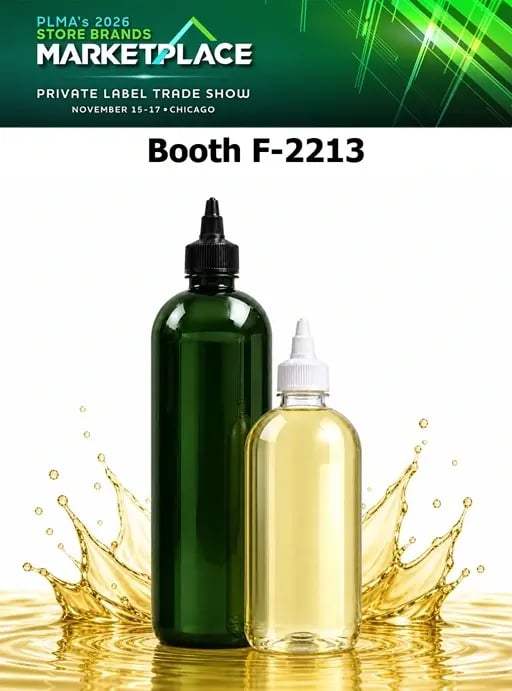
--> Or consider meeting up with us and seeing the bottles for yourself at booth #F-2213 at PLMA's 2026 Private Label Trade Show next week in Chicago