 "Should we contract now or wait?" "Are we on the right side of the market?"
For most edible oil buyers, unique business conditions factor into how these questions are answered.
Demand changes. Consumer/customer purchasing trends evolve. Some promotions outperform expectations, some fall short. Meanwhile, oil markets keep reacting to global crop and harvest conditions, trade policy adjustments, freight impacts, weather patterns, and global events.
The more appropriate question may be: "How much certainty does our business need, and where do we still need room to move?"
For food manufacturers, retailers, distributors, and regional restaurant leaders, the goal is to match your coverage strategy to the way your business operates to minimize risk and maximize margins. No plan is 100% guaranteed to be perfect, but risk factoring helps.
New to commodity oil pricing? Start with this guide to board-and-basis and flat pricing to understand how the two pricing models work and what influences them.
Experienced with commodity oil pricing? Let's take a look at supply contracting strategies below.
First step: determine criteria to measure a successful supplier partnership
Setting up a supplier relationship extends beyond just a competitive price. Determine the supplier criteria that are most important for your business. Evaluate criteria such as quality testing and documentation, customer support, seasonal supply flexibility, compliance and regulatory support, and logistics expertise.
Ask about the suppliers' experience and approach to help make informed decisions across the full lifecycle of an oil program: from sourcing and specifications to quality considerations and changing market conditions. Lean into a partnership built to support both day-to-day needs and longer-term business goals.
Compliance and regulatory issues cannot be an afterthought. What happens when states change packaging codes? What about when nutritional content guidelines change? The best supplier partnerships help you navigate compliance requirements that can affect product selection, documentation, labeling, and supply decisions. By bringing compliance expertise into the conversation early, you can identify considerations and solutions to consider when moving forward with an oil program. Look for suppliers with teams who have a track record of delivering strong proactive customer communication and support. Ask for examples and references.
Supply continuity and market insight also matter when conditions change. What past market dynamics can help you plan proactively for future peak supply? Ask about operational support, category knowledge, and market reports to help you identify and evaluate purchasing and packaging trends.
Second step: balance your contract
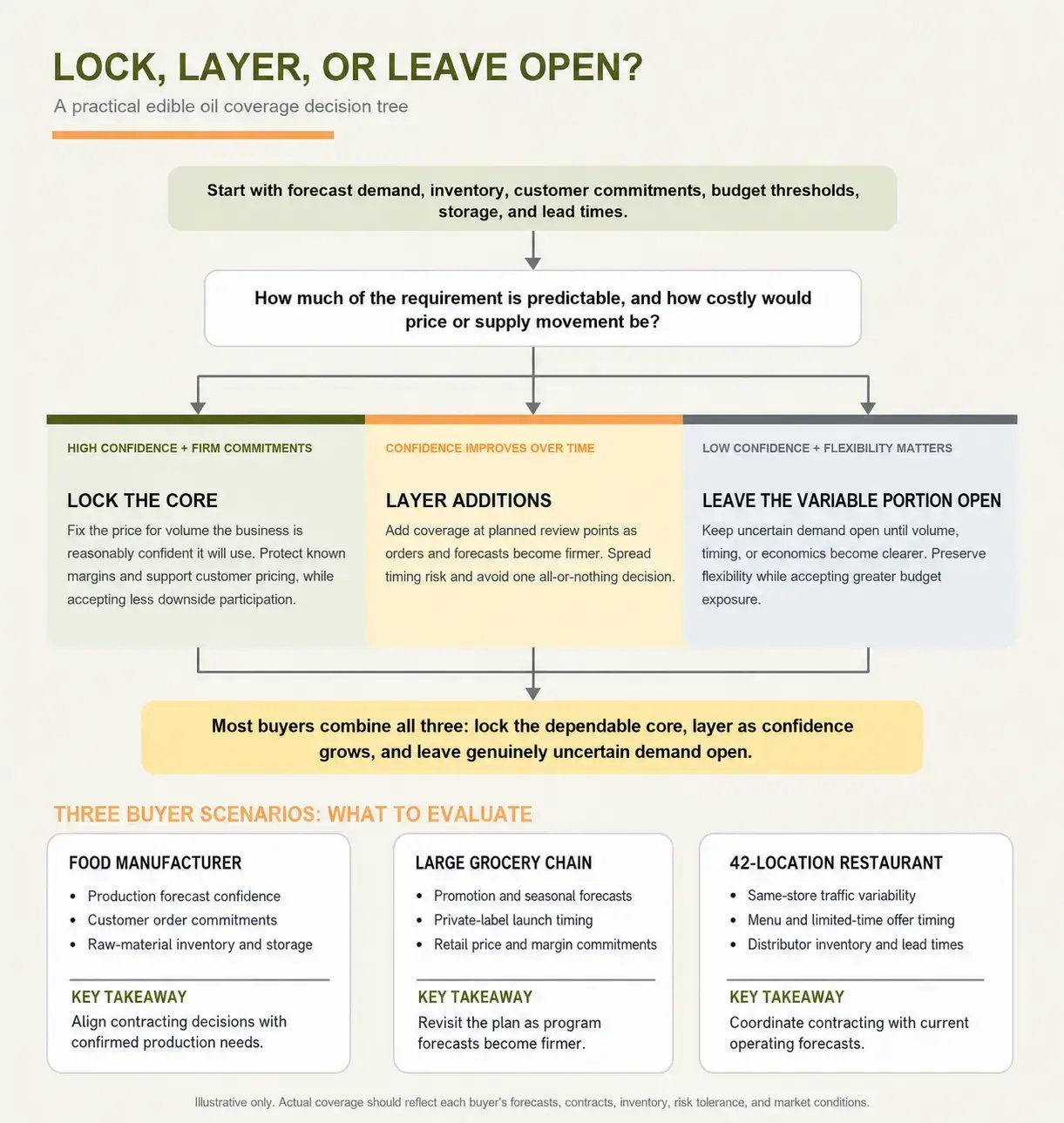
Early in the sales process, walk through the current and past market conditions to understand oil market performance. Weigh this against your company's tolerance for risk. This step helps inform long-term purchasing strategy and is where locking, layering, and leaving pricing open come into play.
| STRATEGY PRINCIPLE | WHAT BUYERS SHOULD KNOW |
|---|---|
| Lock the dependable core | Fixed coverage can support budget certainty when demand and customer commitments are reasonably predictable. |
| Layer as confidence increases | Adding coverage at planned intervals can reduce the risk of making one large timing decision. |
| Leave open the uncertain demand | Open pricing preserves flexibility, but it also leaves the budget exposed to market movement. |
| Combine the three approaches | A blended strategy can align coverage with forecast confidence, operating requirements, and risk tolerance. |
What does it mean to lock edible oil pricing?
Locking means fixing the price for an agreed volume and delivery period.
It’s often worth considering when demand is predictable, margins are tight, or you’ve made firm pricing commitments to customers.
Say a food manufacturer expects to use one million pounds of soybean oil during the next six months. Confirmed orders account for 700,000 pounds. The buyer might lock coverage for those committed pounds while leaving the less-certain volume open.
Certainty has value but it comes with a tradeoff. If the market declines, the locked price won’t participate in that decrease.
What does it mean to leave edible oil pricing open?
Leaving pricing open means waiting until a later date to fix the price.
That flexibility can be useful when demand is still taking shape, inventory is comfortable, or the economics don’t support a longer commitment.
Picture a team preparing an oil program for a retail launch. The start date may shift. Initial volume may change. Leaving part of the anticipated requirement open can help the buyer avoid committing too early.
Of course, waiting carries risk, too. If the market rises, that particular budget is exposed. That’s the tradeoff.
What does it mean to layer edible oil coverage?
Layering breaks anticipated demand into several purchasing decisions instead of fixing everything or leaving everything open at once.
Suppose a buyer forecasts one million pounds of canola oil for an upcoming quarter. The company might lock 50% to protect baseline production, add another 25% as customer forecasts firm up, and leave 25% open.
Another buyer with less predictable demand might start with 30% locked, add coverage at scheduled review points, and keep a larger share open.
Neither buyer is trying to call the bottom of the market; they’re managing the consequences of being wrong.
Why might a blended strategy work better?
You don’t have to choose just one.
Locking, layering, and leaving pricing open are tools. Used together, they can create a coverage strategy that reflects how dependable each part of your forecast really is.
A useful review should consider these eight variables:
-
Forecast accuracy
-
Current inventory
-
Storage capacity
-
Customer pricing commitments
-
Contract timing
-
Supplier lead times
-
Budget thresholds
-
The operational consequences of a supply disruption
A food manufacturer with steady baseline production may choose to lock more of its forecast. A grocery chain might add coverage as promotional plans and oil demand become clearer. A restaurant chain may keep more volume open to account for traffic, menu changes, and seasonal swings.
Certainty matters. So does flexibility.
Catania Oils works through these decisions with customers by reviewing forecasts, inventory positions, contract timing, customer commitments, and risk tolerance. The conversation isn’t simply about where the market might go. It’s about what different market outcomes would mean for your operation.
No strategy removes market risk. A blended approach can make that risk more deliberate, more visible, and better aligned with the business behind the buy.
Third step: start with what you know
Your forecast doesn’t need to be perfect.
Separate it into three buckets: what’s dependable, what’s developing, and what’s genuinely uncertain. That gives you a more useful starting point for deciding what to lock, what to layer, and what to leave open.
Weigh these buckets against the supplier criteria that are important to your business. Understand how quality testing, documentation, customer support, and logistics expertise will assist your team's forecasting and customer communications.
We're here to help. Have a forecast? We can review your current inventory position, market trends, and upcoming customer commitments to shape a practical conversation about the coverage mix that fits your business.
More from the blog
View All Posts
News
Catania Oils Recognized with Brandon Hall Group HCM Excellence Award for Best Use of AI for Learning
Read More
Markets & Pricing
Beef Tallow Supply Is Tight. Does Your Fryer Program Have a Plan B?
Read More
News